September is public outreach month at the World Service Office, and this month’s mailing shows it. A brand-new edition of Al-Anon Faces Alcoholism, a refreshed Public Outreach Toolkit, two notes on how Tradition Eleven works in practice, three sharings from The Forum, and one deadline worth writing down.
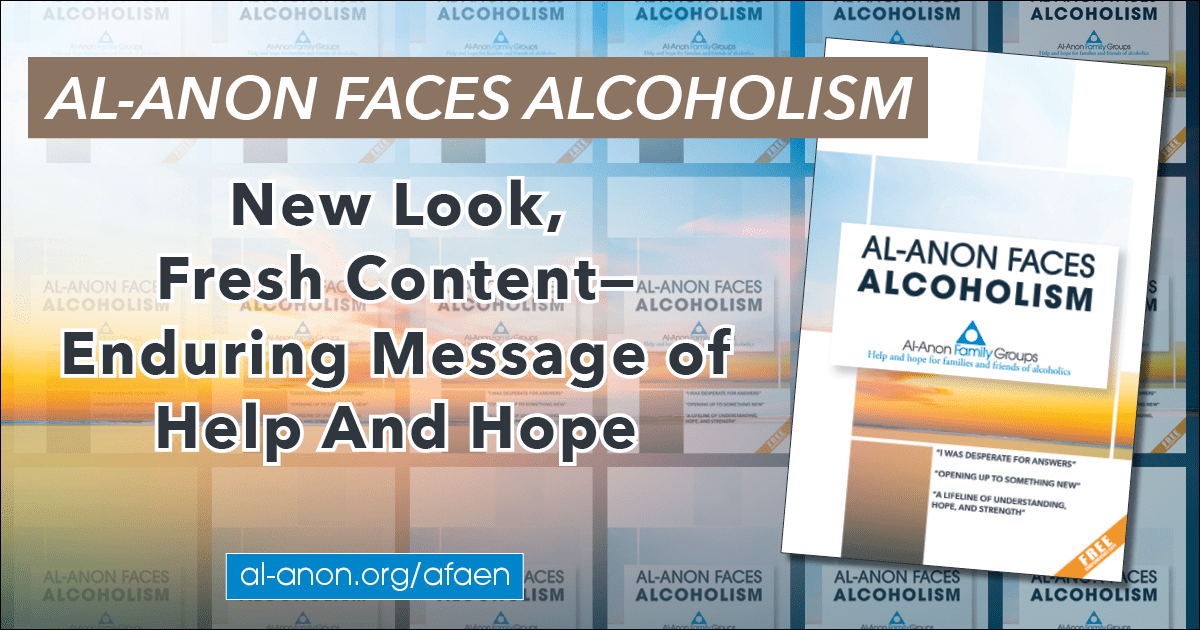
New look, fresh content, enduring message of help and hope — the new edition of Al-Anon Faces Alcoholism

A New Edition of Al-Anon Faces Alcoholism

New look, fresh content — and the same enduring message of help and hope. The redesigned edition of Al-Anon Faces Alcoholism pairs member sharings with articles from professionals to introduce potential newcomers to Al-Anon and Alateen.

Built for public outreach, the magazine helps doctors, counselors, clergy, and other professionals guide the people they serve toward family recovery. You can carry the message by purchasing copies to leave in your community and to hand to professionals who make referrals. Order at al-anon.org/shop.

Deadlines and Ways to Serve

The World Service Office needs your experience, strength, and hope. At-Large members on WSO Volunteer Committees help guide our Conference Approved Literature, shape major public outreach projects, decide which sharings appear in The Forum, and oversee the annual audit.

Five years of continuous Al-Anon experience is required. Submit your résumé at al-anon.org/at-large by October 29, 2026.
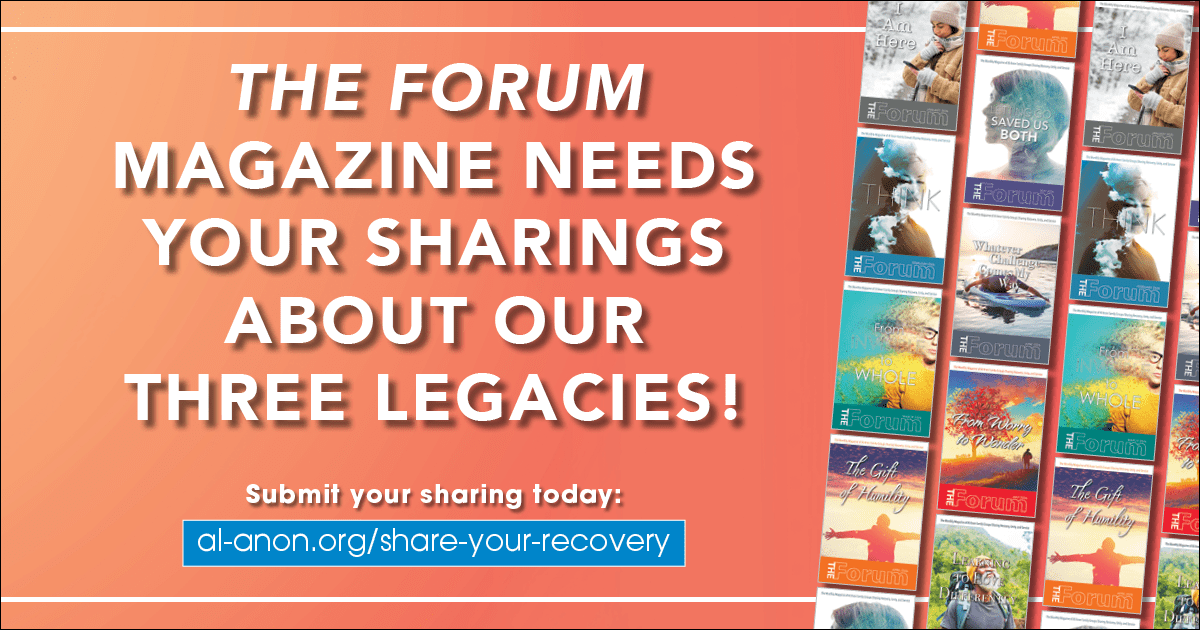
The Forum needs your sharings about our Three Legacies — the Twelve Steps, Twelve Traditions, and Twelve Concepts of Service

The Forum Needs Sharings on the Three Legacies

The World Service Office receives very few sharings about the Twelve Steps, Twelve Traditions, and Twelve Concepts of Service — so if one of them has shaped your recovery, this is an open door. Submissions run roughly 200 to 400 words. Sharings in Spanish or French must include an English translation.

Send to The Forum, 1600 Corporate Landing Parkway, Virginia Beach, VA 23454-5617; email wso@al-anon.org; or submit online at al-anon.org/sharing.
Who's ready for some outreach? Explore the Public Outreach Toolkit at al-anon.org

Who’s Ready for Some Outreach?

New to service, out of ideas, or curious about sharing Al-Anon online and around town? The Public Outreach Toolkit on al-anon.org collects outreach projects that members, groups, and service arms have already tried and proven. It absorbed the best material from the retired Best of Public Outreach and keeps growing as members submit what worked for them.

Browse it at al-anon.org/po-toolkit.
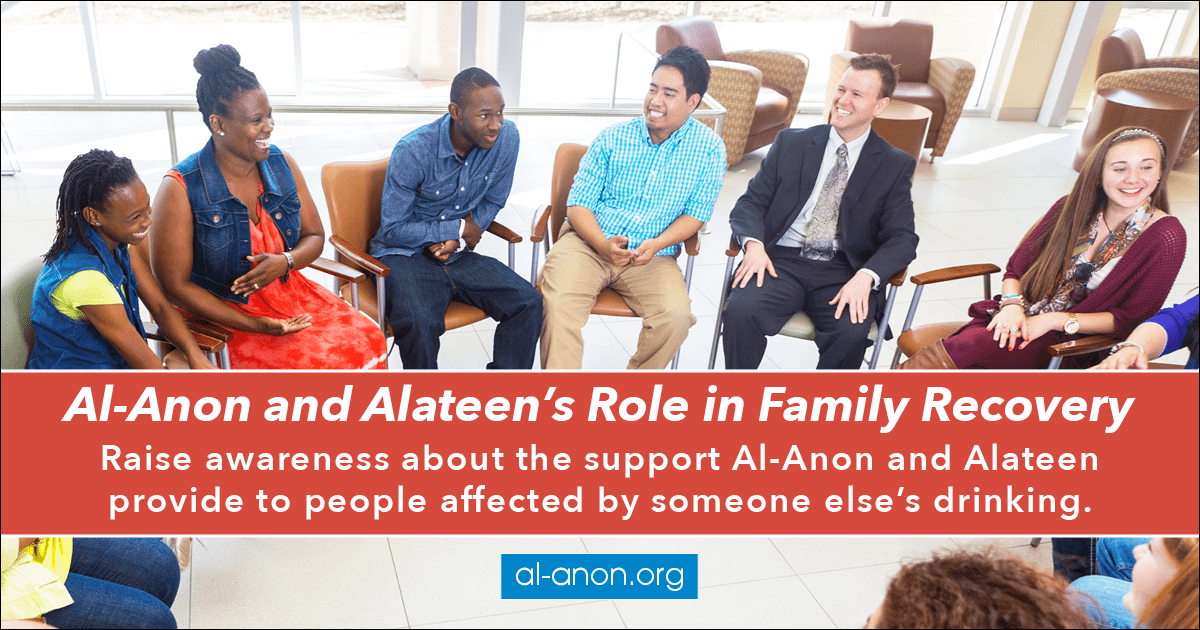
Public outreach DVD: Al-Anon and Alateen's Role in Family Recovery

A DVD that meets your audience where they are. Al-Anon and Alateen’s Role in Family Recovery (AV-31) raises awareness of how our program supports families and friends affected by someone else’s drinking. Interviews with adult members, teen members, and professionals help audiences understand what family recovery looks like.

Sample videos you can share are on the playlist at al-anon.org/av31.
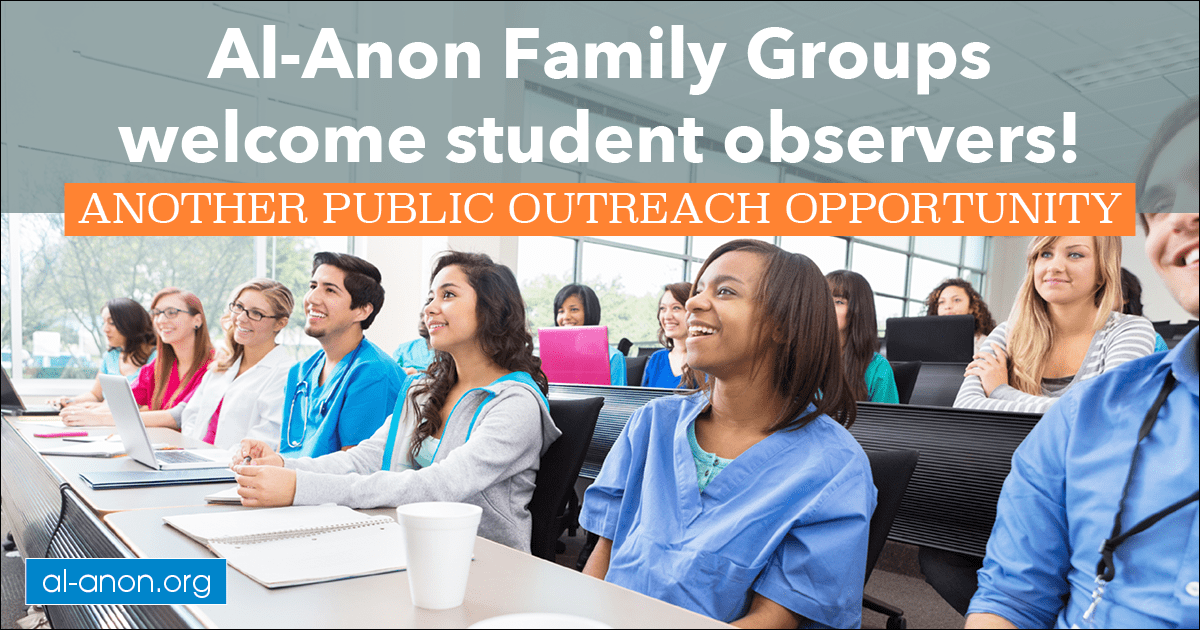
Extending a warm welcome to student observers in Al-Anon meetings

A warm welcome to student observers. Students — professionals in training — come to learn without judgment, and welcoming them carries our message well beyond our rooms.

A friendly greeting, a short explanation of our Traditions, and clear boundaries around anonymity and confidentiality keep the meeting safe while putting Al-Anon principles into action. Opening our meetings with that kind of care invites others to understand how we support families and friends of alcoholics.
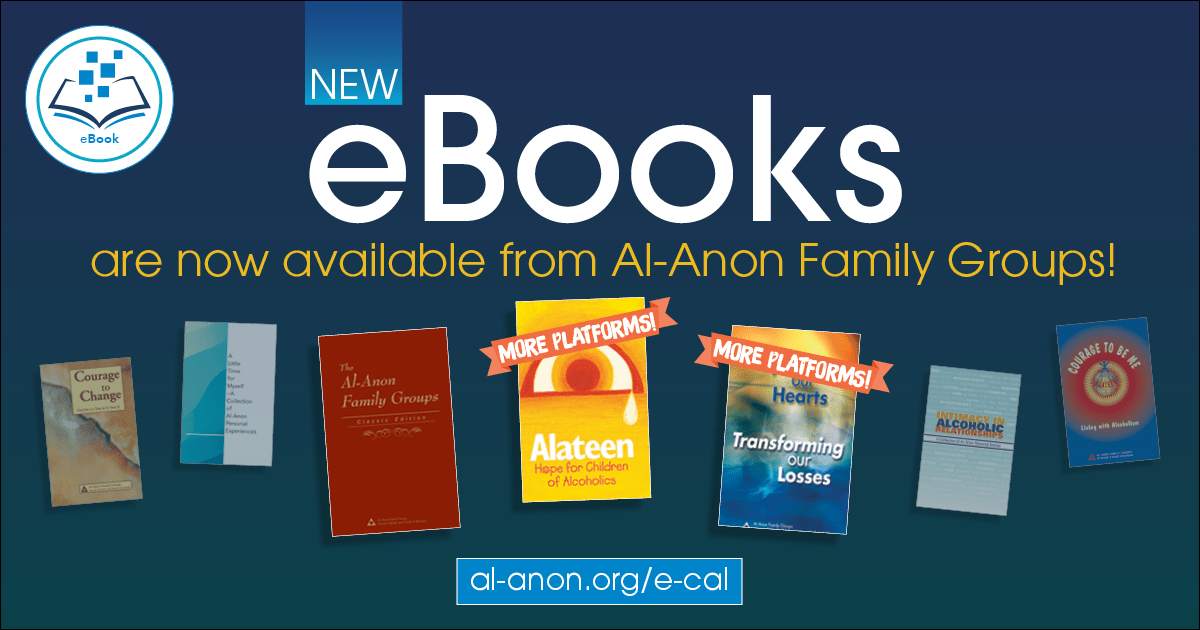
New eBooks are now available from Al-Anon Family Groups

The Latest CAL Titles as eBooks

The World Service Office keeps releasing Conference Approved Literature in eBook format each month. New this month:

  • The Al-Anon Family Groups — Classic Edition (eB-5)
  • Alateen—Hope for Children of Alcoholics (eB-3), now on additional platforms
  • Opening Our Hearts, Transforming Our Losses (eB-29), now on additional platforms

They join a shelf that already holds One Day at a Time in Al-Anon, Courage to Change, Hope for Today, How Al-Anon Works, Discovering Choices, From Survival to Recovery, Many Voices, One Journey, A Little Time for Myself, the 2026–2029 Service Manual, and more. See the full list at al-anon.org/shop.

Inside Al‑Anon Family Groups

Three pieces this month, all circling the same question: how do we stay visible as a program while staying anonymous as members? The first follows two WSO Staff members through the rebuild of Al-Anon Faces Alcoholism. The second sorts out what anonymity actually covers. The third offers practical footing for Tradition Eleven.

What if one simple magazine could create the moment someone begins to feel hope again—to realize they are not alone? For those of us serving as World Service Office (WSO) Staff, this question reflects the heart of our work. Our personal recovery remains closely connected to our daily responsibilities. Whether we are reading member sharings, reviewing professional articles, or revisiting Conference decisions from decades past, we are reminded again and again that Al-Anon’s legacies of recovery, unity, and service are deeply intertwined. The literature and outreach materials we steward are voices of experience, strength, and hope that once supported us at the outset of our journeys and continue to support us today.

One such tool is Al-Anon Faces Alcoholism (AFAM), our public outreach magazine. Al-Anon Faces Alcoholism offers help and hope to people who may not yet know about Al-Anon or the support it provides. To align with the WSO’s longstanding tradition of focusing on public outreach in September, as well as to coincide with national and international campaigns that focus on recovery this month, we are beyond excited to introduce the fully updated and redesigned Al-Anon Faces Alcoholism magazine. Working together across departments on this project has given each of us an opportunity to deepen our understanding of the magazine’s purpose while strengthening our own personal recovery and commitment to carrying Al-Anon’s message to the families and friends of alcoholics.

A Brief History of Al-Anon Faces Alcoholism

As part of our work, we immersed ourselves in the archives, reading original correspondence with professionals and seeing the handwritten notes of Al-Anon’s pioneers. This experience reminded us that public outreach has always required courage, care, and cooperation and that our responsibility is to carry that spirit forward.

Originally published in 1965 as a book titled Al-Anon Faces Alcoholism (B-1), the publication was created to fulfill a twofold purpose: “to spread knowledge of Al-Anon, and to increase local and national income necessary for Al-Anon’s growth” (1965 World Service Conference Summary [P-46], p. 14). For decades, the book served as an important introduction to Al-Anon for professionals and the public.

By the mid-1990s, however, Al-Anon recognized the need to reassess. In 1998, following recommendations from the Outreach to Professionals Advisory, Public Outreach, and Literature Committees, the Board of Trustees discontinued the book due to content that was no longer suitable for professional outreach (1998 World Service Conference Summary, pp. 60, 66).

From 2000 to 2005, the September issue of The Forum magazine focused on public outreach and included information from professionals. At the 2006 World Service Conference, a new approach emerged and was adopted: a dedicated annual outreach magazine available in English, Spanish, and French (2006 WSC Summary, p. 32).

In September 2020, the Public Outreach and Executive Committees approved a change that came from the fellowship: removing the year from the cover to enhance the magazine’s timelessness. The 2021 edition was the first to reflect this update (2020 World Service Office Annual Report, p. 22). During the COVID-19 pandemic, physical distribution was restricted, but an electronic format accessible on the Al-Anon website supported continued sharing and outreach.

Why Al-Anon Faces Alcoholism Matters Today

In 2025, the significance of this publication became increasingly apparent, leading the Board of Trustees to make updating the magazine a priority so that it would remain current and relevant to today’s evolving recovery landscape. Families and friends of alcoholics—and the professionals who serve them—continue to ask for accessible, relatable, and trustworthy resources. Al-Anon Faces Alcoholism helps meet that need.

A Shared Service Effort

Participation was key to the new edition. The fellowship generously responded to the call for sharings, and professional contacts likewise submitted articles for consideration. Members of the WSO Public Outreach Committee reviewed and scored member sharings, while selected WSO Staff reviewed and scored professional articles. Reviewers shared how meaningful the experience was and how deeply moved they were by the quality, honesty, and compassion reflected in the submissions.

While we were unable to publish every submission, this process reinforced a recovery principle we personally know well: writing is never wasted. Sharings that are not selected inform the overall message and often find new life elsewhere. Reading members’ sharings—published or not—also nourishes our recovery, reminding us how much these principles matter.

From Manuscript to Outreach Tool

This update has truly been a joint effort between Literature and Public Outreach, with essential support from other departments throughout the WSO. It is designed to meet people where they are—offering hope to those just discovering Al-Anon, an opportunity to give back for members, and a trusted, informative resource for professionals seeking to understand and refer to our program.

Although the collection and review process was modeled after those used for Conference Approved Literature (CAL) and The Forum, Al-Anon Faces Alcoholism differs in purpose and process. Unlike The Forum, which is a recovery magazine for members, Al-Anon Faces Alcoholism is a service tool developed by Staff and Committees for public outreach, attracting potential members and introducing professionals to our program.

Because it is a service tool, it follows a specific approval process as described on pages 110-11 of the 2026–2029 Al-Anon/Alateen Service Manual (P-24/27). This careful process reflects Al-Anon’s commitment to unity and responsibility.

Looking Ahead

Through its thoughtful periodic renewal as well as its availability in both print and digital formats, Al-Anon Faces Alcoholism will continue to be a key resource for raising awareness of Al-Anon and Alateen while contributing to our self-support. Member and professional contributions enhance its authenticity, reach, and effectiveness.

For us, this project has been a renewing journey in recovery and service. We are grateful to all who contributed to it and to those who help bring its message of hope to others. More than just a magazine, this new edition of Al-Anon Faces Alcoholism offers a simple yet powerful way for members to carry the message to those who may not yet know about the Al-Anon or Alateen programs of family recovery.

We encourage members and professionals alike to share it. You can offer copies to local treatment centers, libraries, or schools; provide it to doctors, therapists, and community leaders; leave it in public spaces like coffee shops, salons, buses, and airports; or send the digital version to someone who may need it. With your help, Al-Anon Faces Alcoholism will find its way into the hands of those who feel alone and hopeless and let them know that there is help and hope in Al-Anon.

By Carol C., Associate Director—Literature, and Heather S., Associate Director—Public Outreach

One of the first things we learn in Al-Anon/Alateen is that members are anonymous—but the program is not. If Al-Anon Family Groups were anonymous, how would newcomers ever find us?

Because the program is not anonymous, Al-Anon can have a public name, website, meeting listings, literature, phone lines, and service offices. This allows Al-Anon to work with professionals and share information with communities that need support for families and friends of alcoholics.

Tradition Twelve reminds us that anonymity is the spiritual foundation of the program, placing “principles above personalities,” and Tradition Eleven protects the anonymity of individual members while ensuring the program remains visible to the public.

What does this mean when carrying the message publicly? Members may use full names within the fellowship, but in all forms of public media—press, radio, TV, films, and the internet—personal anonymity is maintained by using a first name and last initial, a pseudonym, or remaining completely anonymous. When working with professionals, members are encouraged to provide full names and contact details for credibility. In non-media settings, such as health fairs or community presentations, members may choose to use their full names if they feel comfortable doing so.

For more guidance, see Why Anonymity in Al-Anon? (P-33), Attracting and Cooperating (S-40), and the “Anonymity” section of the “Digest of Al-Anon and Alateen Policies” in the Al-Anon/Alateen Service Manual (P-24/27).

When we serve in public outreach, we share clear information without promotion or pressure, attracting people who are seeking help and cooperating with those who serve them. Even small efforts can help someone find hope and connection.

Making Al-Anon and Alateen resources available to the public can be simple yet powerful. Community wellness fairs are an effective way to attract interest while cooperating with local agencies, schools, and health centers. A table with friendly members invites conversation and builds trust. Al-Anon Faces Alcoholism magazines (AFAM), pamphlets, meeting lists, and bookmarks help people find us when they are ready.

Building relationships with professionals is another important part of public outreach. Professionals are often the first point of contact for those affected by alcoholism. Meeting with them at their facilities, offering Al-Anon and Alateen speakers, and providing complimentary literature such as Al-Anon Faces Alcoholism helps build cooperation. Inviting professionals to “Families, Friends, and Observers Welcome” meetings also helps them understand the support our program offers.

Outreach can also happen digitally. Keeping meeting information up to date online or sharing resources through local networks helps people find support anytime.

Public outreach can be done by one member, a small group, or through District and Intergroup committees. Explore simple ways to begin by visiting the “Public Outreach Toolkit” at al-anon.org, and consult the Al-Anon/Alateen Service Manual (P-24/27) and Public Outreach Guidelines for additional guidance.

“Inside Al‑Anon Family Groups” presents news, policy, and commentary from volunteers, staff, and readers sharing experience through service. Reprinted with permission of Al‑Anon Family Group Headquarters, Inc., Virginia Beach, VA.

Sharings from The Forum

Three members this month on why they stayed, a slogan that took years to sit right, and grief tended like a garden.

There are many reasons, but I think the initial one was the connection I made with people who opened their hearts by sharing their trials and struggles, past and present. When I first came to Al-Anon, I didn’t know what to expect, but I quickly found something I hadn’t experienced before. Second, I was finally listened to without being shut down. And third, I felt safe.

The hurt and pain I felt were not unique to me. There were others who suffered from living with the effects of this disease, yet they seemed to be able to smile in spite of it. I envied what they had, and I wanted to have that too.

I tried to find happiness despite my ex’s drinking, but what I really wanted was for him to stop. In Al-Anon, I learned that my peace did not have to depend on someone else’s choices. As I kept coming back, I began to find more peace. My recovery became a remarkable journey of self-acceptance and forgiveness.

I was a child of a mixed marriage, and I had lived with shame about that for much of my life. I loved my father deeply, but I hid my identity and background as much as I could. Through the program, I began to face the part of myself I had avoided for years. This led me to travel to his hometown of Iloilo in the Philippines, and I met my father’s family for the first time. They welcomed me with open arms. I made amends to my father before he passed, for which I am deeply grateful. That was many years ago.

Today, I am blessed to sponsor others, which is a gift in itself. My sponsees have become my friends, and many of them now sponsor others. Being a Sponsor is not easy; it requires patience, understanding, and honesty. I once heard an A.A. speaker who identified as “recovered” joke, “If you don’t hate your Sponsor, you don’t have a good sponsor.”

We laughed, but I understood the meaning. There have been times I didn’t agree with my Sponsor or like what she had to say, but over time, her words proved true. I just wasn’t ready to accept them yet. The experience taught me that growth in Al-Anon doesn’t always feel comfortable, but it’s certainly worth it.

Meetings grant me serenity. Through sponsorship, I have found the power to give and receive love. Sticking with Al-Anon brought me healing, connection, and a community. This sense of belonging and purpose is why I continue to stay and grow.

By Linda C., Wisconsin

When I came to Al-Anon—as a friend of mine says, many moons ago—I remember looking at the sayings on the walls. I didn’t understand at first that they were called slogans or how to apply them to my daily life. Some were easier to try than others. At that time, I felt overwhelmed and believed I was already doing everything for everyone.

Every time I looked at “Let It Begin with Me,” I saw red and became angry. I thought, It always begins with me. I cook, I clean, I pay the bills, I look after the children, and on and on. I felt it was time for someone else to “Let It Begin with Me.”

My attitude toward this slogan went on for quite a while. Over time, through attending lots of meetings and listening to fellow members, my thinking began to change.

I started to see this slogan differently and thought, Why not “Let It Begin with Me”? Everything has to begin somewhere. I began to feel grateful that I could choose to let it begin with me. In Al-Anon, I learned I could make small changes in how I responded, rather than waiting for others to change.

I’m healthy. I have a program to learn from. If I show compassion and love, then it may rub off on someone else. If I can step up and offer myself before being asked, it may make someone else’s life easier. All this good stuff began in my life because of my change in attitude after coming to Al-Anon meetings.

I’ve also come to believe that if I don’t take care of myself, I can’t truly help others.

In my daily life today, I try to “Let It Begin with Me” in many ways:

  • Can I smile and say hello to someone at the checkout first?
  • Can I pause instead of reacting to the words my spouse may say without thought?
  • Can I reach out to an Al-Anon friend instead of waiting for them to call me?
  • Can I take a turn doing the chores while my spouse rests?
  • Can I choose to do the things that make me happy instead of thinking it’s someone else’s job?

Some days are easier than others. There are even moments when I wish things were different, and I remind myself how precious those everyday moments really are.

Has my way of thinking about the slogan “Let It Begin with Me” changed? Yes, completely. It all began because I came to Al-Anon for myself and truly listened to others share their experience, strength, and hope. Is my life free of problems today? No. But when I remember this slogan when I’m having an off day, most times I can get back on track by reading Al-Anon literature or reaching out to someone in the program. What once felt like a burden is now a choice I can make each day.

My lifeline in the Al-Anon program has many good possibilities when I use the slogan, “Let It Begin with Me.”

By Marlene W., Prince Edward Island

This morning, as I grappled once again with the loss of my daughter through estrangement by her choice over the last three years, my Higher Power gave me a perfect metaphor in a quote from the July 5 reading in Courage to Change (B-17). The quote at the bottom of the page reads, “Love your neighbor, yet pull not down your hedge.” This program is teaching me to turn my attention and reliance inward to the sustaining strength of God as I understand this presence within me.

I’ve been fighting an invasive species I planted 15 years ago: Russian sage. It is in one of my garden beds and has taken over all the other plants, and, through its traveling tendrils, it threatens to expand even further. In other beds where I planted it around my house, its spread has been curtailed by cherry trees from volunteer seeds that blew in, took root, and became stronger than the sage. But on this one side, it had free rein.

While contemplating my plants, I began to see them as metaphors for the spiritual lessons I’m learning. The grief I face daily from the loss of the relationship with my daughter can feel overwhelming, causing fear and despair. Like with the sage plant, I can’t fight grief alone, without the help of my Higher Power. The tendrils of grief pop up when my defenses are down, and I realize my powerlessness. But the grace of God can work below the surface without my assistance and, like the cherry trees, fight battles that are beyond my control. These competing species are like the “hedge” in the Courage to Change quote, representing the healthy boundary that must be firm yet porous. I thought about how I’m learning through the principles of Al-Anon to anchor my roots in the soil of God’s love. Instead of sending out tendrils of worry and misplaced desire to help or solve my children’s problems, which are beyond my control, I can reroute those flailing little insecure roots toward my home within, to my sacred center.

Though I will always grieve the loss of the relationship with my daughter, I have to accept, for now, that this is her decision. Through the principles of Al-Anon, I am finding wisdom, happiness, hope, strength, comfort, and healing, for which I am thankful every day.

By Janet L., New Mexico

Reprinted with permission of The Forum, Al‑Anon Family Group Headquarters, Inc., Virginia Beach, VA.
New topic for the Member Blog: what keeps you coming back to Al-Anon?

What Keeps You Coming Back?

When did you decide Al-Anon was right for you, and what has kept you coming back? For some it arrives as a single moment of clarity; for others it grows slowly out of shared experience, strength, hope, and gentle understanding. September’s member blog invites you to reflect on your own journey, or to write on one of the Legacies — this month features Step Nine, Tradition Nine, and Concept Nine.

Share at al-anon.org/member-blog. Sharings on the Member Blog may be used in future Al-Anon publications, and new topics are added each month.